WebP to JPG Converter
Select WebP Image
(Fast JPG Conversion)
More Production Tools
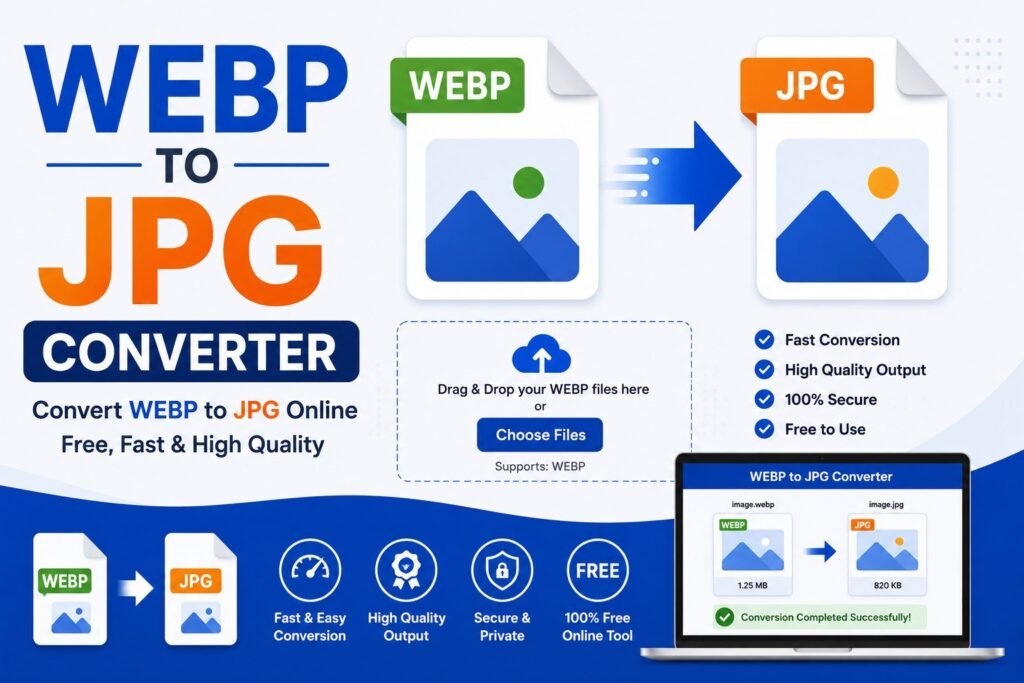
WebP to JPG Converter: Turn Any WebP Image into a Universally Accepted JPG
WebP has become a common format across the modern web because it compresses images efficiently, but that same efficiency creates a real headache the moment you need to use one of those images somewhere else. A WebP to JPG converter tool exists precisely for that moment: it takes an image saved in the newer WebP format and turns it into a standard JPG that virtually every website, app, form, and older piece of software will accept without complaint. This guide explains why WebP files cause so much friction outside the browser, how a dedicated converter handles the switch cleanly, and what to keep in mind so the converted image still looks sharp.
Why You Need a WebP to JPG Converter
WebP was developed to shrink image file sizes for faster-loading web pages, and most modern browsers display it just fine. The trouble starts once that image needs to leave the browser and go somewhere else. Many older or more specialized applications, a large number of upload forms, certain email clients, and various pieces of design and editing software either fail to open a WebP file at all or handle it inconsistently, while JPG remains the one format almost every system can be relied on to accept.
This mismatch is exactly why so many people search for a reliable WebP to JPG converter tool the moment they try to save an image from a website and discover it downloaded as a `.webp` file instead of the `.jpg` they expected. Right-clicking and saving an image, screenshotting a product photo, or downloading a graphic for a document or presentation all commonly produce a WebP file today, and without converting it first, that image can quietly fail to upload, fail to open, or simply refuse to display correctly in whatever program or form it's ultimately needed for.
How Our WebP to JPG Converter Tool Works
Our WebP to JPG converter tool is built to handle this conversion entirely inside your browser, with no account, no software installation, and no need to understand image formats or compression settings yourself. You upload your WebP image, and the tool converts it into a standard JPG automatically.
- Upload your WebP file: Select or drag-and-drop the WebP image from your device into the tool.
- Automatic format conversion: The tool decodes the WebP image and re-encodes it as a standard JPG file.
- Quality preservation: The conversion is handled at a quality level chosen to keep the image looking sharp while producing a reasonably sized JPG file.
- Download the converted image: Save the finished JPG, ready to upload, attach, or open anywhere a WebP file would have been rejected.
Because the conversion happens directly from the image's own pixel data rather than through a screenshot or an indirect workaround, the resulting JPG keeps the same visual detail as the original WebP file, just repackaged into a format that's universally recognized.
Benefits of Using an Online WebP to JPG Converter
A dedicated WebP to JPG converter tool offers several practical advantages over trying to work around an unsupported WebP file manually:
| Benefit | Why It Matters |
|---|---|
| Universal compatibility | Produces a JPG file that virtually every website, app, and program accepts without issue. |
| No quality guesswork | Converts at a sensible quality level automatically instead of requiring manual settings. |
| Works entirely in the browser | No installation and no account, so it works the same way on a laptop as it does on a phone. |
| Handles the format mismatch instantly | Solves the "this file won't upload" problem the moment it appears, rather than requiring a workaround. |
| No cost | Free browser-based tools remove the need for paid software for a simple format conversion. |
These advantages are why so many people converting images downloaded from modern websites consistently prefer a purpose-built WebP to JPG converter tool over trying to open or resave a WebP file through an unfamiliar or unreliable workaround.
WebP to JPG Converter vs Other Methods
Some people try to work around an unsupported WebP file by taking a screenshot of it as displayed in a browser, then cropping the screenshot down to the image itself. This produces a usable JPG in a pinch, but the result is often lower resolution than the original image, may include unwanted background elements, and can look noticeably softer than a proper format conversion.
Others try opening the WebP file in whatever photo editor or app they already have installed, only to find that many common programs, particularly older versions of image editors and productivity software, don't support WebP at all and simply fail to open the file. A purpose-built WebP to JPG converter tool avoids both of these compromises by reading the WebP file directly and converting its actual image data into a JPG, preserving far more detail than a screenshot and working regardless of whether any other installed software recognizes the format.
There's also a real difference in convenience. A browser-based converter handles the file the moment it's uploaded, without needing any particular software already installed on your device, which matters especially on a phone or a shared or work computer where installing a new image editor simply to open one WebP file isn't practical.
Step-by-Step Guide to the WebP to JPG Converter
- Open the WebP to JPG converter tool in your browser on desktop or mobile.
- Upload your WebP file using the upload area or by dragging it directly into the drop zone.
- Let the tool convert the file automatically, turning the WebP image into a standard JPG.
- Preview the converted image to confirm it looks the same as the original.
- Download the JPG file to your device.
- Upload or open the JPG wherever the original WebP file was being rejected.
Common Situations Where This Is Needed
The need for a quick WebP-to-JPG conversion comes up constantly now that so many websites serve images in WebP format by default. Someone saving a product photo from an online store to use in a comparison document, a student downloading a diagram from a website for an assignment, and a job seeker who saved a scanned certificate or ID photo from a source that happened to output WebP all run into the exact same problem: the file downloaded correctly, but the destination they need to use it in won't accept that format.
Online forms are a particularly frequent trigger, since many application portals, from job applications to government and exam forms, explicitly require JPG or PNG uploads and reject WebP files outright, even when the image itself is perfectly usable once converted. Designers and content creators pulling reference images from the web into a presentation or a document, and small business owners saving product images from a supplier's website for their own catalog or listing, are further everyday examples of the same underlying need. In every one of these situations, having a fast, no-install WebP to JPG converter tool bookmarked removes what would otherwise be a recurring point of friction.
Choosing the Right Tool for the Job
Not every WebP to JPG conversion tool handles quality and animation the same way, so it's worth knowing what separates a good one from a mediocre one. Look for a tool that preserves image quality faithfully during conversion, rather than compressing the file down aggressively and losing detail that was present in the original WebP image. Since WebP files can occasionally be animated, similar to a GIF, it also helps to know how a converter handles that case, since converting an animated WebP to a single static JPG will naturally only capture one frame rather than the full animation.
Consider where the conversion actually happens as well. A tool that processes the image locally in your browser, rather than uploading it to a distant server first, tends to be faster for typical image sizes and is generally preferable when the image contains anything personal or sensitive, since the file never has to leave your device to be converted. Finally, a good tool should handle the conversion in a single step without asking for unnecessary settings, since a straightforward format swap shouldn't require more than uploading the file and downloading the result.
Avoiding Common Conversion Mistakes
A few habits before and during conversion can help preserve the best possible result. Starting from the original WebP file rather than a screenshot or a re-saved copy of it keeps more of the original detail intact, since each additional save or screenshot introduces its own small amount of quality loss on top of whatever the conversion itself involves. If the image was originally downloaded from a website, checking whether that site offers an alternate format option before resorting to conversion can occasionally yield a slightly cleaner result.
It's also worth previewing the converted JPG before relying on it for something important, such as a form submission or a printed document, just to confirm the conversion preserved the image clearly and didn't introduce any unexpected artifacts. When only a specific portion of a larger WebP image is actually needed, cropping it down after conversion, rather than converting and uploading the entire original image, keeps the final file focused on just what's required.
Keeping a converted JPG version saved for reuse, rather than re-converting the same WebP file every time it's needed again, can also save time for images like logos, certificates, or product photos that tend to get used across multiple documents or platforms over time. Preparing these conversions in advance of a deadline, rather than discovering a format mismatch at the last minute, similarly avoids unnecessary last-minute stress.
Frequently Asked Questions About WebP to JPG Converter
Is a WebP to JPG converter tool free to use?
Most browser-based converters, including this one, are free with no download or account required.
Why do so many websites save images as WebP instead of JPG?
WebP generally compresses images to a smaller file size than JPG at a similar visual quality, which is why many modern websites use it by default to help pages load faster.
Will converting a WebP file to JPG reduce its quality?
Some quality change is inherent to converting between compressed image formats, but converting at a sensible quality level keeps the difference minimal for most everyday uses.
What happens if I convert an animated WebP file?
Since JPG doesn't support animation, converting an animated WebP file will produce a single static JPG image, typically capturing one frame rather than the full animated sequence.
Does the tool work on mobile phones?
Yes, the tool runs in any modern mobile browser, so you can convert a WebP image into a JPG directly from your phone without needing a computer.
Downloading an image only to discover it won't upload anywhere because of an unfamiliar file format is a common but entirely solvable problem. With a dependable WebP to JPG converter tool, turning any WebP image into a universally accepted JPG takes only a few seconds.