UTI PAN Card Photo & Signature Resizer
Perfectly crop, resolve DPI matrices, and compress document components to strict UTIITSL requirements.
Upload Target Media
Drag & drop document layer or tap to choose file
UTI Official Rules Mapping
| Absolute Dimensions: | 213 x 213 Pixels |
| Required Density: | 300 DPI |
| File Constraint Cap: | Less than 30 KB |
| Absolute Dimensions: | 400 x 200 Pixels |
| Required Density: | 600 DPI |
| File Constraint Cap: | Less than 60 KB |
The engine overrides baseline canvas transparency layers and injects accurate header values to pass UTI database upload parsers seamlessly.
More Production Tools
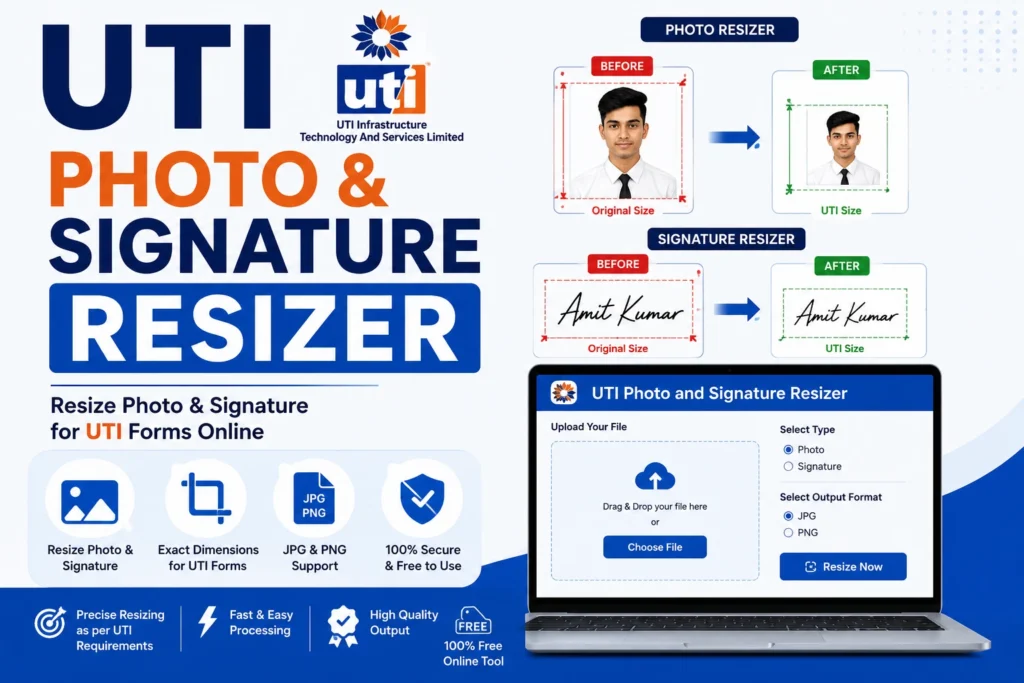
UTI Photo and Signature Resizer: Meet UTIITSL's Exact PAN Card Requirements
If you are applying for a PAN card through UTIITSL and your uploaded photo or signature keeps getting rejected, a UTI Photo and Signature Resizer tool is built specifically to solve that problem. The UTIITSL PAN application portal asks for a passport-style photo and a signature that each meet their own separate, exact specification for pixel dimensions, resolution, and file size, and an image straight from a phone or scanner almost never matches either specification without adjustment. This guide explains both requirements in detail, how a dedicated resizer handles them together accurately, and how to avoid the mistakes that most often lead to a rejected PAN application.
Why You Need a UTI Photo and Signature Resizer
The UTIITSL PAN card application portal specifies two separate sets of image requirements: a passport-style photograph sized at 213 by 213 pixels at 300 DPI and kept under 30KB, and a signature sized at 400 by 200 pixels at 600 DPI and kept under 60KB. Each of these is considerably more specific than a typical online form, since it combines exact pixel dimensions, a defined resolution setting, and a file size ceiling all at once, for two different image types with two different targets.
This is exactly why so many PAN applicants search for a dependable UTI Photo and Signature Resizer tool rather than trying to prepare both files manually. A passport photo taken on a phone and a signature scanned on a flatbed scanner are typically both far too large in file size, at the wrong pixel dimensions, and saved without any defined DPI setting at all. Meeting all three requirements for one image is already difficult with a general photo editor; doing it correctly for two different images with two different target specifications at the same time is where most manual attempts run into trouble.
How Our UTI Photo and Signature Resizer Tool Works
Our UTI Photo and Signature Resizer tool is built to handle both the photo and the signature requirement in one place, switching between the two modes so you can prepare either file, or both, without needing two separate tools. There is no account to create, no software to install, and no need to calculate DPI values or compression settings yourself.
- Choose photo or signature mode: Select whether you are preparing your passport-style photo or your signature, since each has its own target specification.
- Upload your image: Select the photo or scanned signature file from your device.
- Automatic dimension and resolution fitting: The tool resizes your image to the exact pixel dimensions required for that mode, at the correct embedded resolution setting.
- Automatic compression: The tool adjusts compression until the file size falls under the relevant cap, checking the result at each step.
- Download the compliant file: Save the finished photo or signature, ready to upload directly into the UTIITSL PAN application form.
Because the tool checks pixel dimensions, resolution, and file size together for whichever mode you select, it reliably produces a file that satisfies UTIITSL's specific requirement in one pass, rather than leaving you to adjust each property separately and hope they all line up together.
Benefits of Using a UTI Photo and Signature Resizer
A dedicated UTI Photo and Signature Resizer tool offers several clear advantages over trying to prepare both files with a general photo editing app:
| Benefit | Why It Matters |
|---|---|
| Handles both photo and signature in one tool | Switches between two different target specifications without needing separate tools for each file. |
| Meets dimension, resolution, and size together | Fits all three requirements for each file type in a single automated step. |
| Reduces application rejection risk | Avoids the common mistake of satisfying one property while missing another. |
| Keeps photo and signature clear | Balanced compression preserves recognizable detail even at these compact file sizes. |
| No cost | Free browser-based tools remove the need for paid software just to prepare two form uploads. |
These advantages are why PAN applicants across India consistently rely on a UTI Photo and Signature Resizer tool instead of attempting to meet this dual, two-file requirement with a general-purpose image editor.
UTI Photo and Signature Resizer vs Other Methods
Some applicants try to prepare their photo and signature by manually resizing pixel dimensions in a basic editor first, then separately adjusting quality settings and DPI metadata to try to hit each target. This multi-step manual process is difficult to get right for a single image, and needing to repeat it accurately for two different files, each with its own dimension, resolution, and size target, multiplies the chance of a mismatch considerably.
Other applicants focus only on getting the file size small enough and overlook the exact pixel dimensions or the embedded DPI setting, assuming the portal will accept any reasonably compressed image. This is a common cause of PAN application rejection, since UTIITSL's system checks pixel dimensions and resolution specifically, not just whether the file size falls under the cap. Pixel dimensions, resolution, and file size are related but distinct properties of a digital image, and satisfying one does not automatically satisfy the others, which is exactly why a tool built to check all three together, for both file types, is far more dependable than adjusting them separately. A purpose-built UTI Photo and Signature Resizer tool removes this risk by fitting every specification in a single automated step for each file.
Step-by-Step Guide to the UTI Photo and Signature Resizer
- Take a clear passport-style photo against a plain light background, and sign separately on a clean white sheet with a dark pen.
- Open the UTI Photo and Signature Resizer tool in your browser on desktop or mobile.
- Select the correct mode, choosing photo or signature depending on which file you are preparing.
- Upload the corresponding file using the upload area.
- Let the tool resize and compress automatically, fitting the exact pixel dimensions, resolution, and file size cap for that mode.
- Preview the result, then repeat the process in the other mode for the second file.
- Download both files and upload them to the corresponding fields in the UTIITSL PAN application form.
Common Situations Where This Is Needed
The need for this specific tool comes up whenever someone applies for a new PAN card, requests a correction to an existing one, or reprints a lost or damaged card through the UTIITSL portal, since all of these application types require both a photo and a signature upload meeting the same specification. First-time applicants, particularly those applying on their own without help from an agent or service center, frequently discover only after a rejected upload that a standard photo or scanned signature doesn't come close to matching the required pixel size, resolution, and file size all at once.
Parents preparing PAN applications on behalf of children, professionals applying for a PAN as part of a company or firm registration process, and individuals updating their PAN details after a name or address change all encounter the same two-file requirement. Cyber cafes and application-assistance centers that help multiple applicants complete PAN forms during a single sitting also benefit from a fast, reliable way to prepare compliant photos and signatures without switching between separate tools for each file type. In every one of these situations, a dependable UTI Photo and Signature Resizer tool bookmarked and ready to use removes the guesswork and helps avoid a rejected application over a technical formatting issue.
Choosing the Right Tool for the Job
Not every resizing tool online is built around UTIITSL's specific combination of requirements for two separate file types, so it helps to know what separates a good tool from a generic one. Look for a tool that offers a clear switch between photo and signature modes, locking in the correct pixel dimensions and resolution automatically for whichever one you're preparing, rather than a general-purpose resizer that requires typing in dimensions manually for each file and risks a mismatch between the two.
Compression accuracy matters just as much: a good tool should reliably land each file under its respective size cap, checking the result rather than applying one fixed setting that might work for one file type but not the other. It also helps if the tool is specifically designed with both facial clarity and signature legibility in mind, since a photo compressed too aggressively can lose recognizable detail, and a signature compressed too much can turn into an unreadable smudge. Speed and simplicity matter too, since preparing two separate files should still take only a couple of minutes total, without requiring an account or a lengthy setup process.
Avoiding Common Photo and Signature Upload Mistakes
Beyond using the right tool, a few habits before you even begin resizing can prevent a rejected upload later. For the photo, using a plain, well-lit background without shadows or clutter gives the resizing process far less visual detail to compress away, generally producing a clearer result within the tight 30KB cap. For the signature, signing on plain white paper without ruled lines, using a dark and consistent pen stroke, helps the compressed image remain legible, since faint or low-contrast lines are usually the first detail lost during compression.
It's also worth double-checking each finished file against its own specific requirement before submitting the form, confirming the photo reads 213 by 213 pixels and stays under 30KB, and the signature reads 400 by 200 pixels and stays under 60KB, rather than assuming a tool has succeeded without verifying the output yourself. Keeping both properly resized files saved together for future use, rather than starting the resizing process from scratch every time a PAN-related update or correction becomes necessary, can also save valuable time later.
Applicants who are unsure whether their internet connection or device will be reliable at the moment they sit down to complete the UTIITSL form benefit particularly from preparing both compliant files well ahead of time. Having both files ready and saved means fewer steps to complete under time pressure, reducing the chance of a rushed, poorly compressed upload interrupting the application process.
Frequently Asked Questions About UTI Photo and Signature Resizer
Is a UTI Photo and Signature Resizer tool free to use?
Most browser-based resizing tools, including this one, are free with no download or account required.
What exact size and dimensions does UTIITSL require for the photo and signature?
The photo typically needs to be 213 by 213 pixels at 300 DPI and under 30KB, while the signature typically needs to be 400 by 200 pixels at 600 DPI and under 60KB.
Why does my photo or signature still look unclear after resizing?
This often happens when the original photo has poor lighting or the signature scan has low contrast; starting with a well-lit photo and a dark, clean signature generally produces a much clearer compressed result.
Can I use the same resized photo and signature for other PAN-related applications?
Yes, once you have properly resized files that meet the requirement, you can typically reuse them for related PAN applications such as corrections or reprints as needed.
Does the tool work on mobile phones?
Yes, the tool runs in any modern mobile browser, so you can prepare both your photo and signature directly from your phone before submitting a UTIITSL PAN application.
A rejected PAN application over a photo or signature file size, dimension, or resolution mismatch is a frustrating but entirely avoidable problem. With a dependable UTI Photo and Signature Resizer tool, meeting both requirements takes only a couple of minutes before you submit your application.